
Risposta: In 2026, precision-driven tattoo machine technology refers to engineering advances that optimize how the needle moves through skin — focusing on acceleration control, mechanical stability, and stroke consistency rather than raw power. The goal is to reduce skin trauma, improve pigment placement, and give artists repeatable, predictable results across every session.
Why Is “Precision” the Biggest Trend in Tattoo Machines Right Now?
For decades, the tattoo industry measured machine quality almost entirely by power output — voltage, hits per minute, and needle depth. The conversation was simple: rotary vs. coil, wired vs. wireless.
That conversation has fundamentally changed.
In 2026, the artists who consistently produce the sharpest lines, the smoothest gradients, and the fastest-healing work are not necessarily working with the most powerful machines. They are working with the most controlled ones.
The shift is from brute force to intelligent motion. And it’s reshaping what professionals look for when choosing equipment.
What Makes a Tattoo Machine “Precision-Driven”?
A precision-driven macchina per tatuaggi is not defined by marketing language — it is defined by how its drive system interacts with skin at the moment of needle penetration.
Key characteristics include:
Controlled stroke acceleration. The needle should not simply push into the skin with maximum force on every cycle. A precision drive system manages how energy is delivered during the stroke, so the needle enters cleanly rather than forcing through tissue.
Mechanical stability without spring tension. Springs introduce variability — they behave differently under varying hand pressures, skin resistances, and session lengths. A mechanically stabilized drive reduces vibration, runs quieter, and stays consistent regardless of changing conditions.
Consistent behavior at lower voltage. A machine that requires high voltage to perform is a machine compensating for inefficiency. Precision engineering allows reliable performance at a controlled, lower voltage range — which directly reduces skin trauma and speeds healing.
Stroke customization for different work types. Lining, shading, and color packing each demand different needle behavior. A precision machine offers multiple stroke length options so the artist can dial in the exact mechanical profile for their technique.
How Does Needle Stroke Length Affect Tattoo Quality?
Stroke length — the distance the needle travels per cycle — is one of the most important and underappreciated variables in tattooing.
A shorter stroke (3.2–3.5mm) gives tighter, crisper control, ideal for fine line work and detail-heavy styles. A longer stroke (4.2–4.7mm) drives ink deeper and with more authority, suited to bold traditional work, heavy shading, and large-scale color saturation.
The problem with most machines is that stroke length is fixed. An artist working across multiple styles either compromises, or carries multiple machines.
In 2026, professional-grade machines offer configurable stroke options so one machine can serve multiple applications without sacrificing performance in any of them.
What Is K-PULSE™ and Why Are Artists Talking About It?
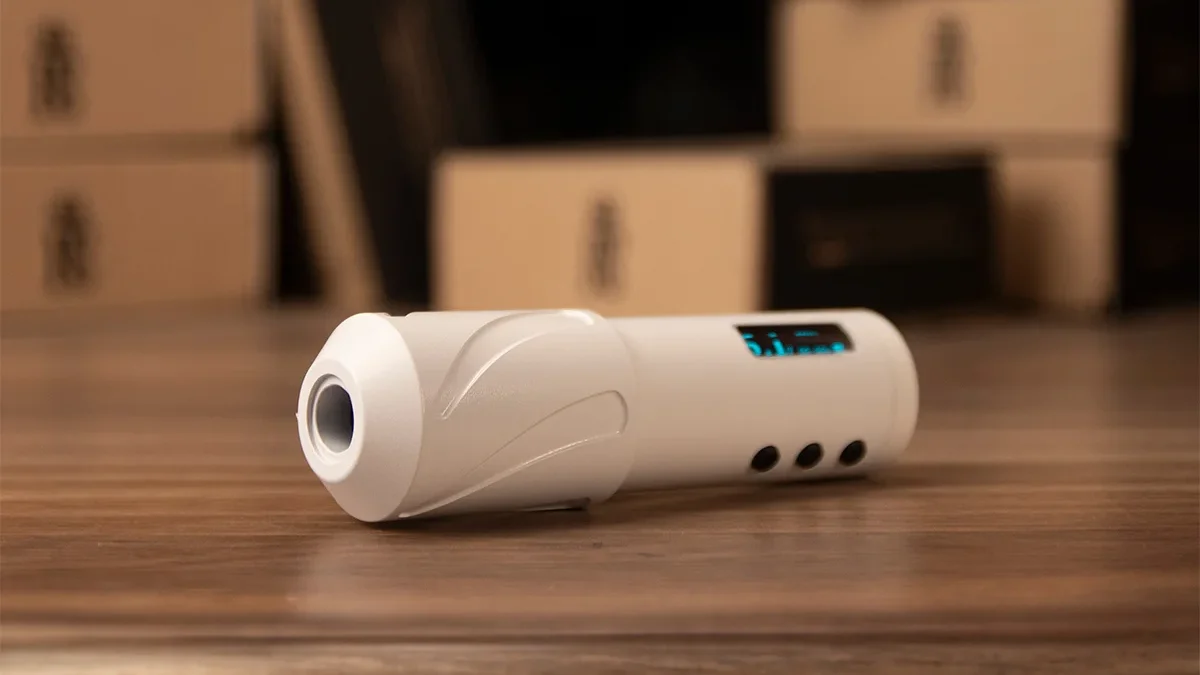
K-PULSE™ is the proprietary drive technology behind the RightStuff REVO wireless tattoo machine. It represents a different philosophical approach to how a tattoo machine should function.
Rather than building around maximum force — the traditional “push harder, compensate with power” model — K-PULSE™ is designed around acceleration control. The system optimizes how the stroke behaves at the precise moment of skin penetration, redistributing energy so the needle enters with higher effective acceleration without increasing voltage or requiring additional hand pressure.
What this means in practical terms for the artist:
- Smoother needle entry with less resistance from the skin
- Less need to push or compensate with technique
- More consistent pigment placement on the first pass
- Reduced overworking of the skin
- Cleaner results and faster healing for the client
Crucially, K-PULSE™ is not software, firmware, or a digital system. It is mechanical behavior — engineered into the physical drive — which means it works at all voltages, with all needle configurations, and does not depend on battery level or external calibration.
What Are the Technical Specs of the RightStuff REVO?
The REVO is built around the principle that the smallest machine should not mean the least capable. Its full specifications:
| Specification | Detail |
|---|---|
| Technology | K-PULSE™ drive system |
| Batteria | 2,600 mAh — up to 12 hours continuous use |
| Stroke options | 3,2 / 3,5 / 3,8 / 4,2 / 4,7 mm |
| Max needle depth | 4,5 mm |
| Motor speed | 10.000 GIRI/MIN. |
| Voltage range | 3–7V (preferred operating range) |
| Grip diameter | 33 mm |
| Machine length | 112,5 mm |
| Peso | 170g (standard) / 195g (heavy) |
| Body material | Alluminio |
| Cartridge compatibility | Tutte le cartucce standard |
The REVO is currently RightStuff’s most compact wireless pen, available in 11 colorways and with optional stainless steel grip for artists who prefer additional weight.
View the REVO at RightStuff.eu →
Does Precision Technology Replace Artistic Skill?
No — and this point matters.
The goal of precision-driven engineering is not to automate the artistic process. It is to remove the mechanical friction that stands between an artist’s intention and the result on skin.
When a machine is fighting the artist — vibrating unpredictably, requiring constant voltage adjustments, behaving differently as the battery drains — the artist spends cognitive and physical energy managing equipment rather than executing creative work.
A machine built around mechanical precision removes those variables. The depth, pressure, speed, and stroke behavior stay consistent. The artist’s decisions about composition, flow, shading depth, and line weight are expressed directly — without a layer of mechanical unpredictability obscuring them.
This benefits experienced artists through repeatability: every pass on every session feels familiar. It benefits developing artists through feedback: the machine’s consistent behavior makes it easier to understand what technique changes are producing what results.
The machine becomes an extension of the hand, not a variable to manage.
Who Is the RightStuff REVO Built For?
The REVO is positioned for working professionals who need a single machine capable of performing across styles and session lengths.
The 12-hour battery makes it a genuine all-day machine — not a machine that needs to be tethered midway through a long session. The five stroke length options mean it adapts to different techniques rather than requiring the artist to adapt to it. The K-PULSE™ drive system means performance stays consistent whether the artist is working at 3.5V on delicate fine-line work or pushing toward 7V for heavy color saturation.
It is also a machine designed to cause less fatigue — both for the artist’s hand and for the client’s skin. Lower required hand pressure over a long session compounds into meaningfully less physical strain. Less skin trauma per session means clients heal faster and return more confidently.
Domande frequenti
What voltage should I run a wireless tattoo pen machine? For most precision wireless machines, a range of 3–7V is standard. Lower voltages (3–4.5V) suit fine line and detail work; higher voltages (5–7V) are used for color packing and bold shading. Machines with precision drive systems like K-PULSE™ often perform effectively at the lower end of that range, reducing skin stress while maintaining ink saturation.
What stroke length is best for fine line tattoos? A 3.2mm or 3.5mm stroke is generally preferred for fine line work, giving tighter control and more precise needle placement. Longer strokes (4.2mm+) are better suited to shading and traditional bold work.
How long does a wireless tattoo machine battery last? Battery life varies significantly by machine. The RightStuff REVO runs up to 12 hours on its 2,600 mAh battery — one of the longest continuous run times in the professional wireless pen category.
Is a precision tattoo machine better for beginners? A mechanically consistent machine benefits artists at every level. For beginners specifically, predictable and stable behavior makes it easier to develop technique — the machine’s consistency means feedback from each pass is accurate, so the artist learns what their own inputs are producing rather than trying to account for mechanical variability.
What is the difference between a rotary and wireless pen tattoo machine? All wireless pen machines are rotary machines — “wireless” refers to the power source (battery rather than external power supply), while “rotary” refers to the drive mechanism (motor-driven circular motion rather than electromagnetic coil). The two terms describe different aspects of the same machine type and are not mutually exclusive.
 English
  Deutsch
  Polski
  Français
  Italiano
  Español