
Antwort: A beginner tattoo artist needs five core things to start practicing properly: a reliable tattoo machine, a power supply, tattoo needles or cartridges, ink, and practice skin. Everything else — grips, transfer paper, gloves, cleaning supplies — builds around those five. The most common mistake beginners make is buying an overcomplicated kit with too many components before they understand what each one does.
What Type of Tattoo Machine Should a Beginner Start With?
This is the most important decision, and it is also where most beginners get it wrong — either by spending too little on something that teaches bad habits, or by buying a professional-tier machine before they have the technique to use it well.
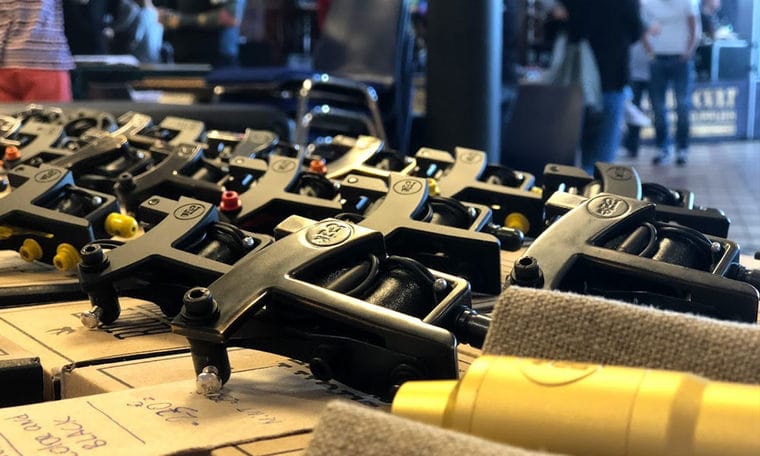
In 2026, the clearest recommendation for beginners is a rotary pen machine. Here is why:
Rotary pen machines are quieter, lighter, and mechanically simpler than coil machines. They require no tuning, no spring adjustments, and no technical knowledge to set up — you connect power, set your voltage, and work. This means your energy goes into learning the technique rather than managing the equipment.
Coil machines are the traditional choice and still preferred by many experienced artists for specific work, particularly bold traditional tattooing. But they require understanding of spring tension, contact screw adjustment, and maintenance that is genuinely distracting for someone at the beginning of their learning curve. Learn on a rotary pen, understand the fundamentals, and explore coil machines later if the style calls for it.
For beginners looking at the RightStuff range, the pen tattoo machine category offers solid options at different price points — machines that are consistent enough to give you honest feedback from your technique without overwhelming mechanical complexity.
What Voltage Should a Beginner Run Their Tattoo Machine At?
Start low and work up from there. For most rotary pen machines, a voltage range of 5–7V covers the majority of beginner work on practice skin.
The instinct for beginners is often to run higher voltage — the machine feels more powerful, and the ink seems to go in more easily. The problem is that higher voltage increases skin trauma, makes it harder to control needle depth, and masks poor technique by forcing ink in rather than placing it precisely.
Starting at a lower voltage forces you to develop proper hand speed, pressure, and angle, which are the actual skills that produce clean work. When your lines are clean and consistent at 5V, increasing the voltage gives you more capability. When your lines are inconsistent at 7V, more power just makes the inconsistency worse.
A good rule: if you are pressing harder to get ink in, the answer is usually technique, not more voltage.
Should Beginners Use Cartridge Needles or Traditional Needles?
For beginners in 2026, cartridge needles are the clear choice. Here is the practical difference:
Traditional needles are single-use needle groupings that need to be mounted into a grip and tip assembly, which requires the right grip size, correct depth setting, and some mechanical familiarity. They are cheaper per unit but add setup complexity.
Cartridge needles are self-contained — the needle group, tip, and safety membrane are all in one unit that clicks into a cartridge grip on the machine. Setup takes seconds, there is no mounting, no tip sizing to worry about, and the safety membrane prevents ink from travelling back into the machine.
For a beginner, cartridges mean less time on setup and more time on the actual skill of tattooing. The RightStripes cartridge range covers all standard configurations — round liners, magnums, curved magnums — and is compatible with all standard cartridge grip machines.
What Needle Configurations Does a Beginner Need?
You do not need every needle type to start. Three configurations cover the vast majority of beginner practice:
Round Liner (RL) — used for outlines and line work. The needles are arranged in a tight round cluster. Start with a 5RL or 7RL — small enough to be controllable, versatile enough for most line work.
Round Shader (RS) — used for shading and small colour fills. Similar cluster arrangement to a liner but with needles set slightly further apart to allow ink to spread. A 7RS or 9RS is a good starting point.
Magnum (M1 or curved magnum/CM) — used for larger shading areas and colour packing. The flat or curved arrangement moves ink across a wider area per pass. Curved magnums are generally preferred as they follow the skin’s surface more naturally.
Start with these three. Add specialty configurations — flat shaders, bugpins, stacked magnums — as your technique develops and you understand what you actually need them for.
What Ink Should a Beginner Use?
Use professional tattoo ink from the start, even on practice skin. There are two reasons for this.
First, cheap or unknown inks behave differently from professional inks — the viscosity, pigment load, and flow characteristics affect how the ink enters the skin (or practice skin) and how easily it saturates. Learning from inconsistent ink means you cannot isolate whether a problem is technique or material.
Second, if you ever practice on real skin — your own or a volunteer’s — cheap ink is a genuine safety concern. Professional tattoo inks are formulated and tested for skin use. Unknown inks are not.
Start with black. It shows contrast clearly on practice skin, teaches you to read saturation accurately, and covers the majority of what you will be doing in early practice. Add colours once your line consistency and shading control are solid.
Die ink range at RightStuff covers professional-grade options suitable for both practice and real application.
What Is Practice Skin and Do You Actually Need It?
Yes — practice skin is essential before working on real skin, and it should be used extensively.
Synthetic practice skin simulates the resistance and layering of real skin well enough to teach the fundamentals: how deep the needle needs to penetrate, how fast to move, how much pressure to apply, what saturation looks like, and how lines behave at different angles. It is forgiving in the sense that mistakes have no consequences, but honest enough that good technique produces visibly better results than poor technique.
The progression most experienced artists recommend: spend weeks on practice skin before touching real skin. Do not rush this stage. The habits you build on practice skin — hand speed, needle angle, pressure consistency — are the habits you will carry into real work.
Fruit skin (particularly grapefruit or orange) is sometimes used as a cheap alternative for practicing curves and contours, as it mimics the rounded surface of body parts. It is not a replacement for proper practice skin, but it is useful as a supplement.
What Other Equipment Does a Beginner Need?
Beyond the machine, cartridges, ink, and practice skin, a functional beginner setup requires:
Power supply. If your machine is not wireless, you need a power supply — a unit that converts mains power to the DC voltage your machine runs on, with a dial to set voltage precisely. Look for one with a clear digital display and a footswitch connection. The RightStuff power supply range covers reliable options for wired setups.
Cartridge grip. If using cartridge needles, you need a cartridge grip — the handle section that the cartridge clicks into. Grip diameter affects comfort; most beginners start with a standard 25–30mm grip.
Tattoo gloves. Non-negotiable for hygiene. Nitrile gloves are standard — latex allergies are common enough that nitrile is the safer default.
Transfer paper. For transferring a design outline onto skin (or practice skin) before tattooing. Thermal transfer paper works with a thermal copier; spirit-based transfer paper works by hand application. For practice, either works.
Green soap or similar skin prep solution. Used to clean the skin surface before and during tattooing. Diluted green soap on a paper towel is the standard approach.
Paper towels. Used constantly — wiping excess ink, cleaning between passes and general workspace hygiene.
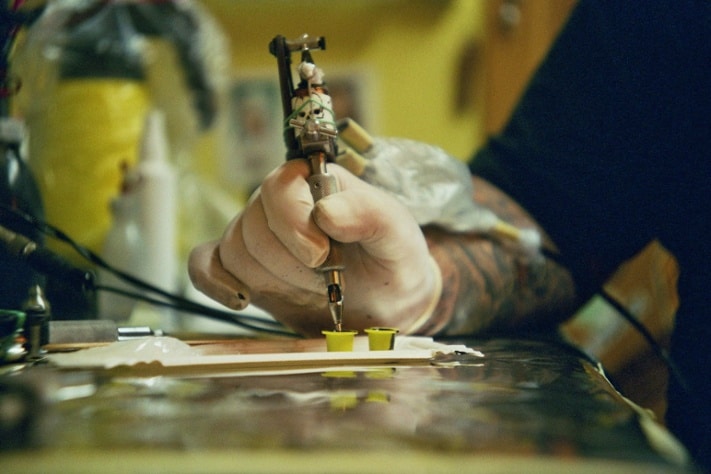
Ink caps. Small disposable cups that hold ink during a session. Never dip your needle directly into the main ink bottle — always pour a small amount into a cap for each session.
What Is the Right Order to Learn Tattooing Skills?
This is a question beginners rarely ask but should. Jumping straight to complex shading or detailed line work before the fundamentals are solid is the most common reason beginners plateau early.
A sensible progression:
1. Straight lines. Before anything else, practice drawing consistent straight lines on practice skin at a steady hand speed. This teaches machine control and hand steadiness. Do this until lines are clean and consistent.
2. Curved lines and circles. Curves require rotating your wrist while maintaining consistent pressure and speed. Harder than straight lines, and foundational for almost all real tattooing.
3. Black fill and shading. Learn to saturate an area evenly — no streaks, no missed patches, no overworked sections. This teaches you to read ink saturation as you work.
4. Simple designs. Once lines and fill are consistent, combine them into simple designs — geometric shapes, simple flash designs, anything with clear outlines and fill areas.
5. More complex work. Script, portraiture, detailed illustrative work — these come later, after the fundamentals are genuinely solid.
Rushing this progression does not save time. It just delays the point at which your work looks professional.
Häufig gestellte Fragen
How long does it take to learn to tattoo? There is no fixed timeline, but most artists describe 6–12 months of consistent practice on skin (not just practice skin) before their work reaches a level they are proud to charge for. The fundamentals — clean lines, even shading — can be developed in weeks of dedicated practice. The refinement takes much longer.
Can I learn to tattoo at home without an apprenticeship? Technically, yes, and many artists do — particularly in areas where formal apprenticeships are scarce. However, an apprenticeship provides something self-teaching cannot: direct feedback from an experienced artist watching your technique in real time. If an apprenticeship is available to you, it is worth pursuing alongside self-practice.
What voltage should I use for lining vs shading? For lining, many artists prefer slightly higher voltage (6–8V) for faster, crisper needle movement. For shading, lower voltage (4–6V) gives more control over gradients. These are starting points — your specific machine, needle configuration, and hand speed all affect what works best for you.
Do I need a wireless machine as a beginner? Not necessarily. Wireless machines are genuinely more convenient — no cord management, freedom of movement — but a wired setup with a good power supply teaches the same fundamentals. If budget is a factor, a reliable wired rotary pen with a quality power supply is a perfectly solid beginner setup.
What is the difference between a liner and a shader needle? Liner needles (RL) are grouped tightly together, creating a small, precise point that produces clean lines. Shader needles (RS, M1) are grouped more loosely or spread into a flat configuration, allowing ink to saturate a larger area per pass. In practice: liners for outlines, shaders for fill and gradient work.
<script type="application/ld+json">
{
  "@context": "https://schema.org",
  "@type": "Article",
  "headline": "What Does a Beginner Tattoo Artist Actually Need to Get Started?",
  "description": "A practical 2026 beginner's guide to tattoo equipment — covering machine types, needle configurations, voltage settings, practice skin, and the right order to learn tattooing skills.",
  "image": "https://eadn-wc03-16019892.nxedge.io/cdn/wp-content/uploads/2019/12/cnt_6_1.jpg",
  "author": {
    "@type": "Organization",
    "name": "RightStuff Tattoo Machines",
    "url": "https://rightstuff.eu"
  },
  "publisher": {
    "@type": "Organization",
    "name": "RightStuff Tattoo Machines",
    "logo": {
      "@type": "ImageObject",
      "url": "https://eadn-wc03-16019892.nxedge.io/cdn/wp-content/uploads/2021/05/rs_logo-160x40.png"
    }
  },
  "datePublished": "2020-12-10",
  "dateModified": "2026-03-08",
  "mainEntityOfPage": {
    "@type": "WebPage",
    "@id": "https://rightstuff.eu/blog/a-beginners-guide-to-the-tattooing-world/"
  }
}
</script>
 English
  Deutsch
  Polski
  Français
  Italiano
  Español